Welcome to Keep Looking Up, the blog series written by our planetarium team, where we share fun space stories and what you might see if you keep looking up.
Fifty-seven years ago, we landed on the Moon.
In an address to Congress on May 25, 1961, against the heated backdrop of the Space Race, President John F. Kennedy declared that the nation “should commit itself to achieving the goal, before this decade is out, of landing a man on the Moon and returning him safely to the Earth.” Eight years later on July 16, 1969, the Saturn V rocket carrying command module pilot Michael Collins, commander Neil Armstrong, and lunar module pilot Edwin “Buzz” Aldrin Jr. launched from the Kennedy Space Center in Florida as the crew embarked on their four day and approximately 238,855-mile-long journey to the Moon within the cabin of the Columbia Command Module, which was no bigger than the size of a car.
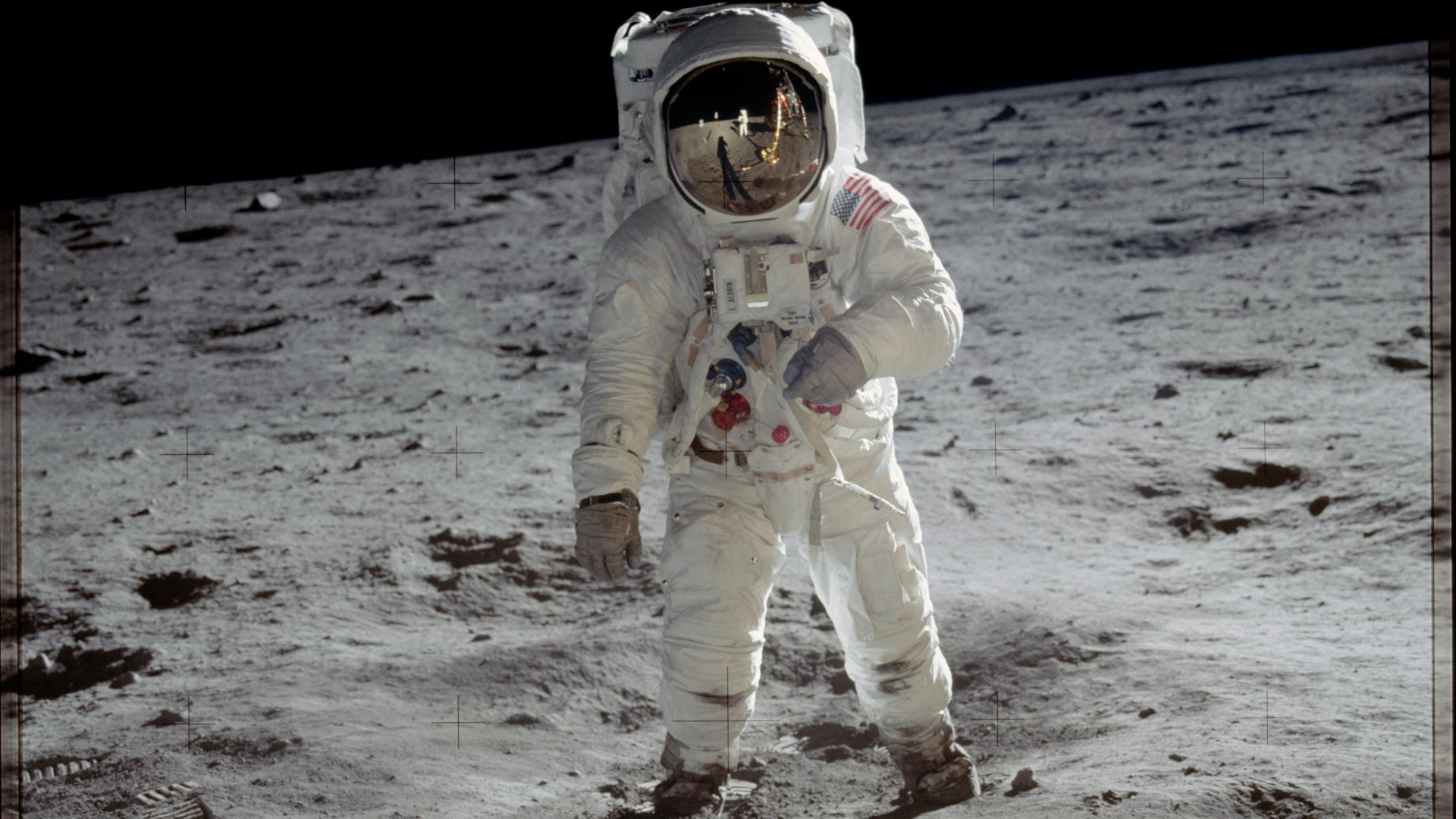
It was an extremely high-risk mission; the first of its kind. The Apollo 11 crew were fully aware of its potentially tragic outcomes when they set out on their epic journey. In fact, life insurance agencies refused to cover the astronomically high policy rates, so the crew devised a plan to leave behind hundreds of autographed envelopes for their friends to stamp with significant mission dates, which their families could later sell to cover living expenses and the cost of their kids’ college education. Presidential speechwriter William Safire had even prepared an alternative speech, “In Event of Moon Disaster,” for President Richard Nixon to address the world had our astronauts been unable to return from their lunar journey. Luckily, neither was needed as fate and history had different plans for the crew. On July 20, 1969, at 10:51 p.m. ET, an estimated 650 million people watched live from planet Earth as Neil Armstrong became the first human to set foot on another celestial body, followed by Buzz Aldrin nineteen minutes later. A triumphant Armstrong declared the now iconic “that’s one small step for a man, one giant leap for mankind,” as his first words. We commemorate this historic achievement annually on July 20, known as National Moon Day.
Fun Fact: Armstrong has since revealed he was misquoted, as he actually said, “that’s one small step for a man,” though the article “a” wasn’t picked up by the transmission, likely due to static. After decades of scholarly analysis and debate, the article is now often included in brackets.
During the two hours Aldrin and Armstrong spent exploring the relatively flat region of the lunar surface, known as Mare Tranquillitatis or “the Sea of Tranquility,” the duo collected data and conducted a series of experiments that provided invaluable scientific insights into our nearest celestial neighbor. Seismometers from the mission have helped us measure moonquakes, and special mirrors, known as laser retroreflectors, that were left on the Moon by the Apollo 11 crew and successive missions continue to be used to determine the distance between the Moon and Earth with extreme precision, leading to the confirmation that the Moon is slowly drifting away from our planet. The 21.6 kg of lunar rock and soil samples collected by the Apollo 11 crew and successive missions have been shared with over a hundred countries to promote the collective advancement of human knowledge.
While the original American flag planted by the Apollo 11 crew was knocked over by the exhaust of the Lunar Module during liftoff and has since deteriorated and turned white, bathed in solar radiation, the descent stage of the Eagle, Apollo 11’s Lunar Module, which was left behind during the mission, can still be seen by lunar orbiters. The Apollo program relied heavily on human innovation. Many everyday items and technology were initially developed by the Apollo engineering team, including freeze-dried food, cordless vacuums, flame-resistant clothing, studless winter tires, memory foam, emergency thermal mylar blankets, anti-fogging and scratch-resistant lens coating, and much more!
Fun Fact: Upon splashing back down to Earth in the Pacific Ocean, the crew entered a cautionary three-week-long quarantine to monitor the effects of the lunar environment on the human body and potentially prevent the spread of any non-terrestrial pathogens that might have tagged along.
The legacy of the Apollo missions lives on in NASA’s Artemis Program, which plans to return humans to the Moon and establish a lunar base to prepare for the next giant leap…landing humans on Mars! Images and data collected from the Artemis II mission, whose astronauts completed a crewed lunar flyby earlier this year and broke the record for the furthest distance traveled from Earth, are now on display in Frost Science’s vizLab!
The story of the Apollo missions isn’t just one of three astronauts but rather one of the over 400,000 people who were part of the Apollo workforce whose contributions made it possible to land on the Moon, and the culmination of millennia of scientific advancements shaped by millions. Follow the story of flight and those who dared to dream in our Feathers to the Stars exhibition and the Black Wings: American Dreams of Flight poster exhibit!
Exploring the cosmos with Frost Science doesn’t have to end within the walls of our exhibits. Track the monthly phases of the Moon by cataloging observational data with our Frost Science@Home Activity Toolkit. Join us on one of our outreach demonstrations as we expand access to the stars with the rest of our South Florida community. Take a guided tour of our universe in our Portable Planetarium or spend the evening under the stars with a Night Sky Telescope Viewing, each a personalized educational experience and opportunity to witness celestial phenomena with one of our Frost Science team members.
July’s Cosmic Forecast:
Make sure to keep an eye on the sky as Mars and Saturn will be visible in the southeast morning sky all month, with Venus appearing in the west during the evening. Telescope viewers will get a rare view of Saturn’s rings, which currently appear thinner than usual as a result of the planet’s tilt relative to our view on Earth but are gradually making their return throughout the rest of the year. The Southern Delta Aquarids Meteor Shower will also reach its peak on July 29 and 30, which will send around twenty meteors shooting across the sky per hour!
And, as always, keep looking up!