Welcome to Keep Looking Up, the blog series written by our planetarium team, where we share fun space stories and what you might see if you keep looking up.
The release of Christopher Nolan’s The Odyssey, an adaptation of the timeless Greek epic transcribed by Homer, has made massive waves at the box office as moviegoers flocked to theaters this summer. In the story, Odysseus and his crew must embark on a decade-long journey and face the wrath of the gods to return home after the Trojan War. This literary classic is filled with references to the night sky, providing key insights into ancient astronomical knowledge and celestial navigation in the West.
While fleeing the island of the nymph Calypso, one of the many obstacles on his voyage home, Odysseus evades sleep by stargazing and keeping his eyes “fixed on the Pleiades, on late-setting Bootes, and on the Bear—which men also call the Wain, and which turns round and round where it is, facing Orion, and alone never dipping into the stream of Oceanus—for Calypso had told him to keep this to his left.” (Source: Project Gutenberg)
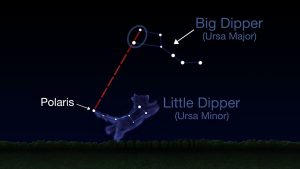
Image Credit: NASA
Here, the Bear references the constellation Ursa Major, more commonly known as the Big Dipper. Homer notes this constellation as the only one that never dips into the waters of Oceanus. Ursa Major is visible throughout the year from most of the Northern Hemisphere and is circumpolar, or appearing to never set below the horizon, above the mid-northern latitudes, making the Big Dipper a reliable compass for travelers. The Big Dipper itself doesn’t point directly north, but its two outer stars point observers towards Polaris, the North Star. Because Polaris appears almost still while the rest of the sky rotates around it, ancient sailors used the star as a guide to maintain their general sense of direction while traveling the Mediterranean Sea.
Fun Fact: The ancient Greeks had a completely different North Star!
The Earth’s axis of rotation is tilted, giving us our seasons but also causing a wobble, a phenomenon known as precession in physics, determining which star the north celestial pole points toward. As with the many people who have held the title of President of the United States, the title of the North Star belongs to the star closest to the north celestial pole. There are even times when no star perfectly occupies this position, as was the case at the height of the Roman Empire and is currently the case in the southern hemisphere. Polaris, our current North Star, only took the title in 500 AD and will be replaced by Gamma Cephei within the next 2,000 years before returning to the position in 26,000 years, a complete cycle of precession.
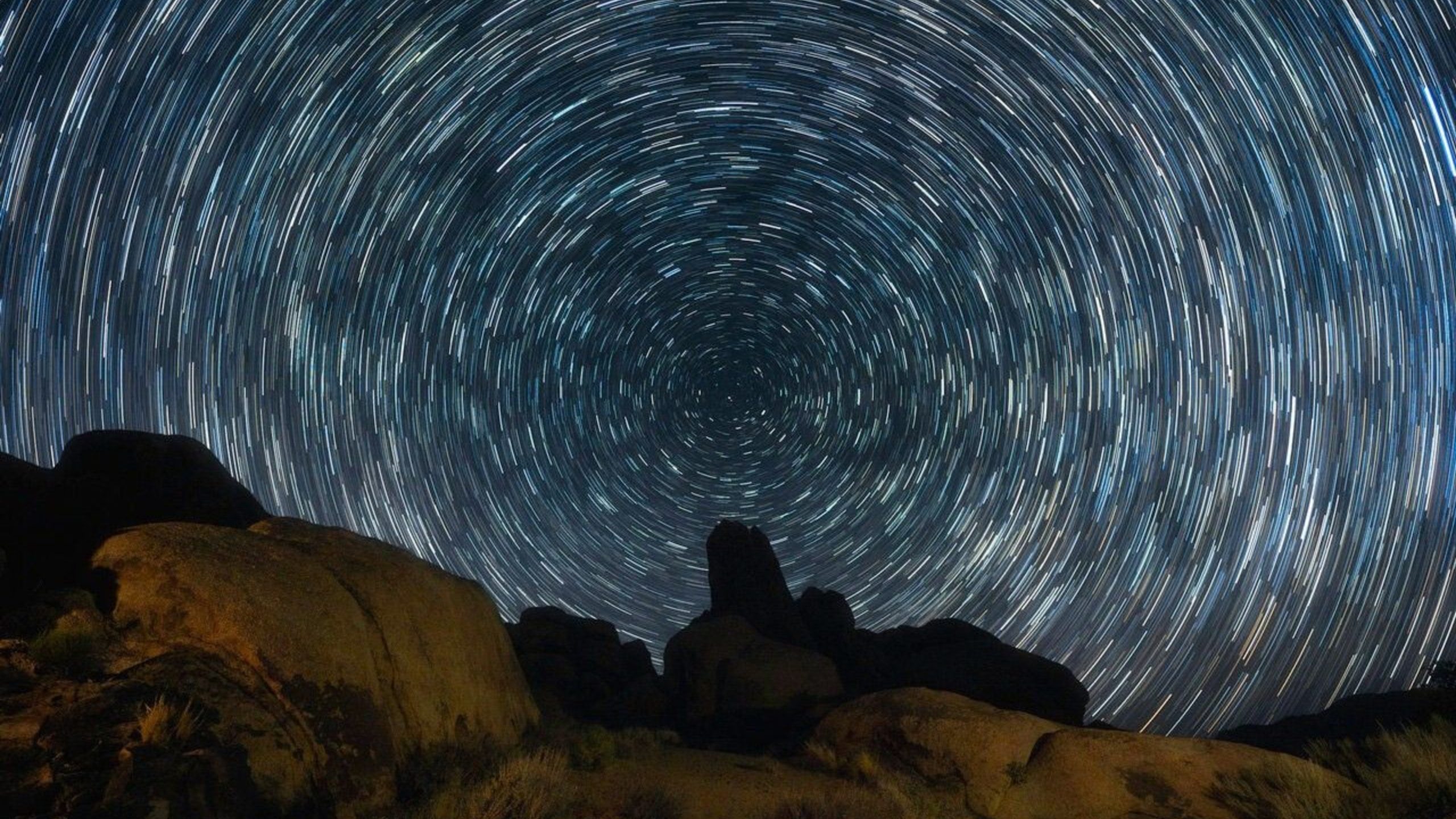
A timelapse reveals Polaris, or the North Star, appearing stationary in the night sky of the northern hemisphere. (Image Credit: NASA)
The Earth’s axis of rotation is tilted, giving us our seasons but also causing a wobble, a phenomenon known as precession in physics, determining which star the north celestial pole points toward. As with the many people who have held the title of President of the United States, the title of the North Star belongs to the star closest to the north celestial pole. There are even times when no star perfectly occupies this position, as was the case at the height of the Roman Empire and is currently the case in the southern hemisphere. Polaris, our current North Star, only took the title in 500 AD and will be replaced by Gamma Cephei within the next 2,000 years before returning to the position in 26,000 years, a complete cycle of precession.
The Pleiades, otherwise known as the Seven Sisters, are a group of stars that formed together from the same nebula, a stellar nursery or cloud of gas and dust. These are called open star clusters and can contain up to a few thousand stars. The other celestial object mentioned is Boötes, a constellation that appears east of the Pleiades in the night sky. Ancient people around the world named these constellations after myths and legends. The name “Boötes” means “herdsman,” referring to the keeper of domesticated animals.
Orion is another well-known constellation that is easily spotted during the winter months. It is one of the most recognizable constellations, often called “The Hunter” because ancient Greeks imagined the stars forming the shape of a warrior. While Orion doesn’t directly “face” the Big Dipper, the two constellations can be used together to navigate the night sky.
At the time of Odysseus’ fictional travels, Greek navigators used instruments known as astrolabes to find their way at sea. This device aided navigators in making trigonometric calculations by measuring the angular distance between celestial bodies and the horizon, determining one’s latitude, and serving as a model of the night sky. The astrolabe was succeeded by the sextant centuries later, serving as the primary scientific instrument for seafaring navigation between the “old world” of the East and the “new world” of the West.
In the twenty-first century, the Global Positioning System (GPS) has replaced our reliance on the stars for navigation, but those same constellations that guided ancient sailors still connect us to the explorers of the past. If you spend some time stargazing, you may see what appear to be slow-moving stars traversing these very constellations. These are artificial satellites placed in the sky by the descendants of those who dared to look up and dream of travel. These satellite networks provide the infrastructure for the GPS technology that fits in our pockets!
Humanity’s dreams of the stars extend far past the Mediterranean. When the people of the Innu Nation looked up at night, they saw a great celestial canoe whose movement throughout the sky guided their seasonal hunting routes across northern Canada. In Japan, the colors of the stars themselves reflect a great rivalry between the Genji and Heike clans for control of Japan, immortalizing the battlefields of the Genpei War in the night sky. In India, royal Jai Singh ordered the construction of the Samrat Yantra, a grand astronomical observatory and sundial that remains accessible to all even today, to better understand the stars themselves by cataloging observational data with extreme precision. The stories of these three cultures and their connections to the sky are highlighted in “One Sky,” an international series of short films now showing at the Frost Planetarium!
Exploring the cosmos with Frost Science doesn’t have to end within the walls of the museum. Join us on one of our outreach demonstrations as we expand access to the stars with the rest of our community in South Florida. Take a guided tour of our universe in our Portable Planetarium or spend the evening under the stars with a Night Sky Telescope Viewing, each a personalized educational experience and an opportunity to witness celestial phenomena with one of our Frost Science team members.
September’s Cosmic Forecast
Make sure to keep an eye on the sky this month, as the fall equinox will occur on Tuesday, September 22, at 8:04 PM EDT, marking the official first day of astronomical fall. The fall equinox is an astronomical event where the Sun sits almost directly above the Earth’s equator. The Sun then will shine on both hemispheres nearly equally, meaning the day and night will be about the same length. The full Moon closest to the autumnal equinox is popularly called the Harvest Moon. The name originated from ancient European farmers, as it is said that the light from the Moon helped them work late into the night while harvesting crops.
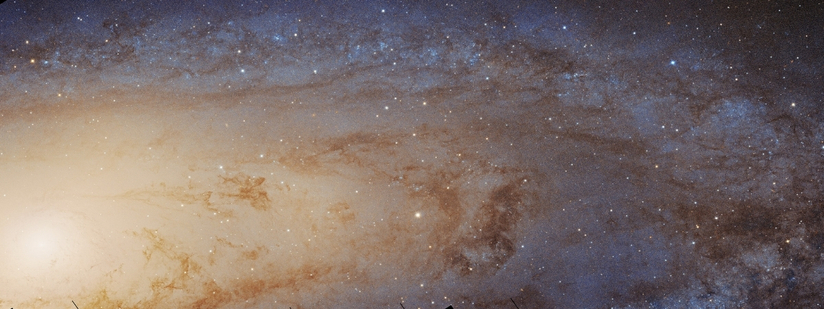
The Andromeda Galaxy (M13) (Image Credit: NASA)
This month, the Harvest Moon will occur on Saturday the 26th, while the New Moon will take place on Thursday the 10th. The New Moon is a perfect opportunity to go stargazing for celestial objects like the Andromeda Galaxy (M13) that is at its highest for the year. The Andromeda Galaxy, which is the nearest large spiral galaxy to the Milky Way at about 2.5 million light years, will reach its highest point in the sky towards the end of the month. In South Florida, it will be located about 50 degrees above the horizon, appearing like a faint, elongated smudge from suburban skies, but for darker rural skies, the Andromeda Galaxy will appear larger than the full Moon. Another sight to see is Saturn, which reaches its highest point in the sky around midnight but can be seen as early as 10 PM. One practical advantage to September nights are longer astronomical nights. Darkness falls earlier than in August, and the planet is well above the horizon well before midnight, making it perfect for school night observing with the family before bedtime. As the autumn nights begin to arrive earlier, it’s always nice to peek outside and see what you can find in the night sky.
And, as always, keep looking up!