I’m Dr. Cary Woodruff, Curator of Vertebrate Paleontology at Frost Science. Take a step into my office with this monthly blog series and let’s dig deeper.
By the time you’re reading this, I’ll be hitting the road to begin my seasonal drive westward to Montana. And before the start of the dig season, for the next two months I’ll be busy with science-education outreach events, a giant research trip, and more! So, this gives us a good opportunity to dive into some of 2026’s new paleontology research, and there’s probably no better place to start than Spinosaurus mirabilis. (pronunciation: Spinosaurus spy-no-sore us; mirabilis mirror-ah-ba-liss)
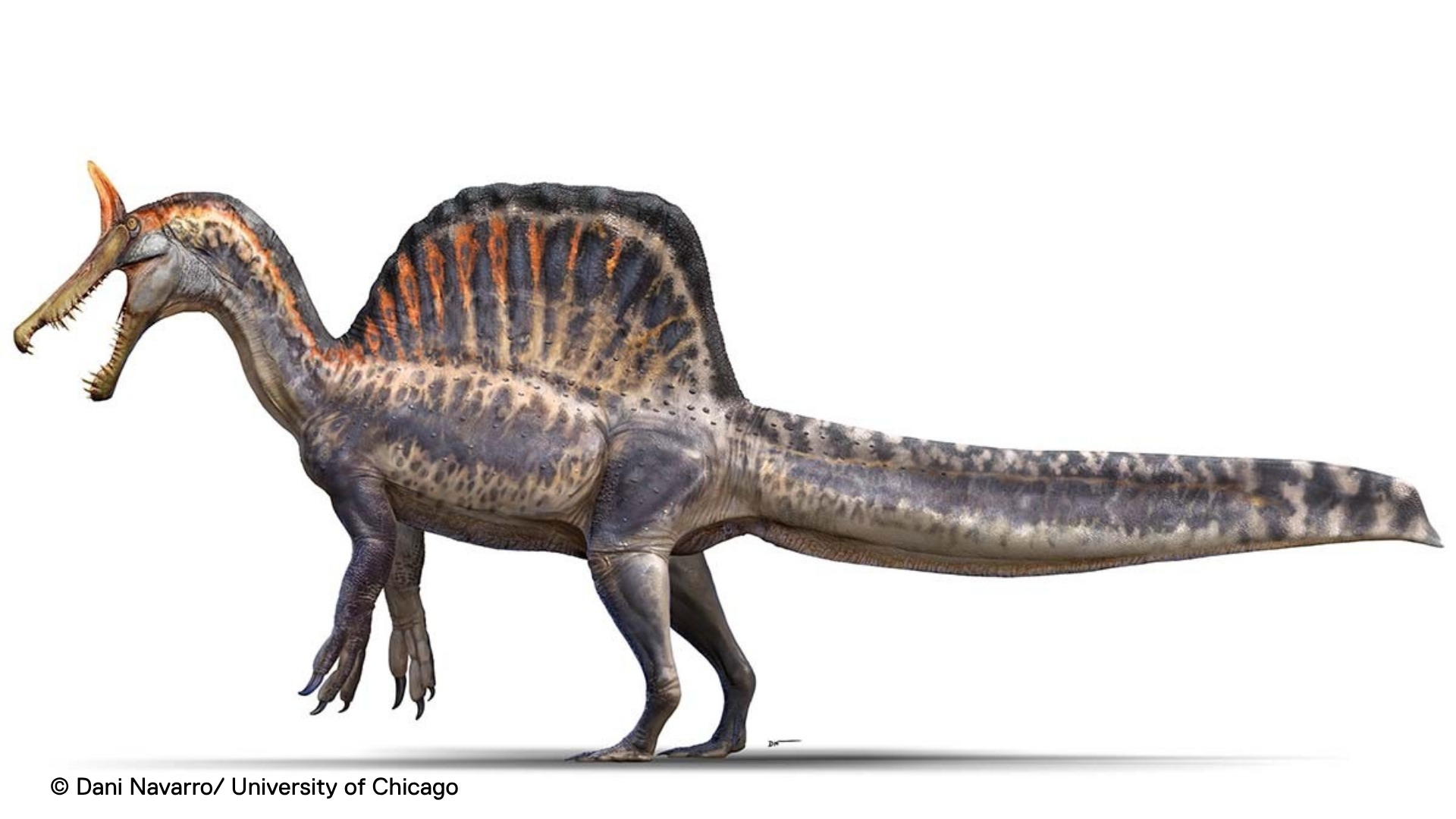
Spinosaurus was made famous as the villain in Jurassic Park III. With a long, crocodile-like snout, long arms with big claws, and a ~6 ft. tall sail on its back, Spinosaurus not only looked radically different from other top predatory dinosaurs (like Tyrannosaurus rex), it was also bigger (longer; T. rex was still heavier). The first fossils of Spinosaurus were discovered in Egypt in the early 1900s, but these fossils were unfortunately destroyed by Allied bombing during the Bombing of Munich during WWII. We won’t wade into the fray, but the short answer is EVERYTHING about Spinosaurus is contentious. Its size, its weight, the proportions and reconstruction of its skeleton, what it ate, how it fed, its lifestyle, and anything else you can possibly think of is the topic of heated debate.
So, a second species of this dinosaur surely couldn’t cause a fuss, right?
Though there’s not much of the skeleton, fortunately, there are lots of pieces from several individuals. From these pieces, the team of paleontologists that described S. mirabilis thinks it was about 15% smaller than the larger species of Spinosaurus (S. aegyptiacus; pronounced ah-jip-tah-kiss). But that’s not what makes S. mirabilis stand out. On top of its head between its eyes, S. mirabilis sported a ~20-inch-long curved crest.
So, why the crest?
There’s increasing evidence that the iconic sail of Spinosaurus was used for display, so, it’s likely that the head crest of S. mirabilis was an additional visual display. And if true, this further emphasizes how important visual signaling was to these animals. Imagine all of the flashy feathers that a male peacock uses to show off; so, like these display feathers, the sail – and crest – in Spinosaurus was likely for showing off (but a ~25 ft. long, ~5 ton, ‘peacock’ that could eat you). So, were these displays used to show off to potential mates? Or to ward off rivals? Both? Or something else? Whatever the reasons, such discoveries are further revealing how complex and fascinating the dinosaurs were.