I’m Dr. Cary Woodruff, Curator of Vertebrate Paleontology at Frost Science. Take a step into my office with this monthly blog series, and let’s dig deeper.
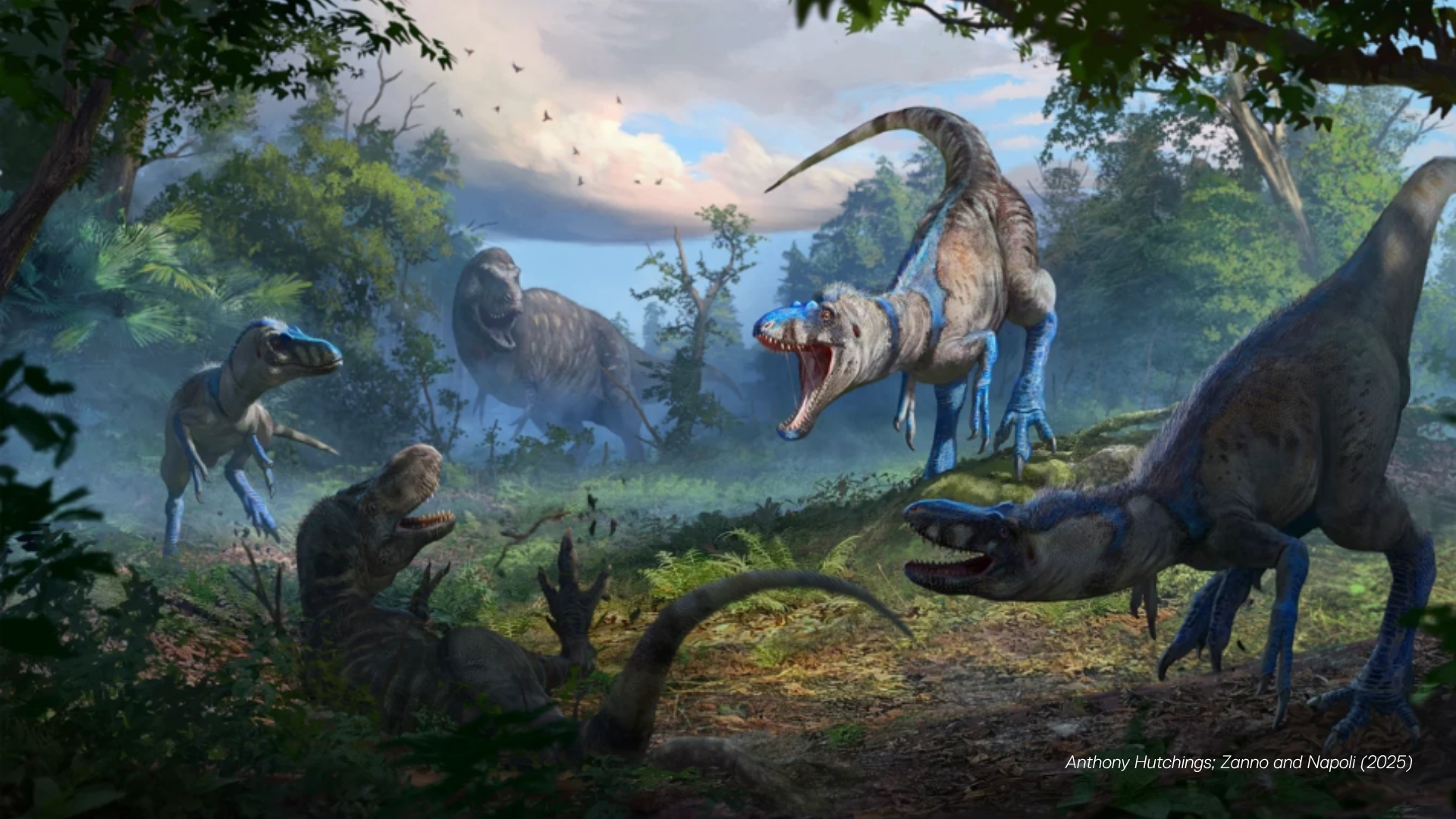
One of the greatest dinosaur debates of the past 20 years or so centers around a dinosaur called Nanotyrannus (pronounced nan-o-tie-ran-us). Nanotyrannus lived 66 million years ago in the Hell Creek Formation alongside the famous dinosaurs Ankylosaurus (an-kye-low-sore-us), Pachycephalosaurus (pack-e-seff-ah-low-sore-us), Triceratops (try-sarah-tops), and Tyrannosaurus (tie-ran-oh-sore-us). In fact, Nanotyrannus was hypothesized to be closely related to Tyrannosaurus, and it was further hypothesized that in the Hell Creek Formation, there were species of large (Tyrannosaurus) and small (Nanotyrannus), closely related predatory dinosaurs stalking this ancient environment.
While there were some differences—like proportions of some of the bones and number of teeth, essentially the major and striking way to tell Tyrannosaurus and Nanotyrannus apart was that Nanotyrannus was much smaller. And then the scientific debate floodgates opened.
One group of scientists thought that Nanotyrannus was a legit and valid species, despite these slight differences. Let’s explore wolves and coyotes from Yellowstone National Park as an example. They both live there, are canids (members of the dog family), and other than size and a few proportional differences, it’s hard to tell the two apart. But another group of scientists proposed a radical idea: What if Nanotyrannus was just a ‘teenage’ Tyrannosaurus? Look at young animals today, they can have extreme and noticeably different proportions from the adults (for example, the big heads of human babies, the large paws of puppies, to the long, gangly legs of baby horses and cows). And in all our years of searching, we’d never found a young Tyrannosaurus—but there are several Nanotyrannus. And, when paleontologists cut open the bones to calculate their ages at death, all of the Tyrannosaurus sampled were basically 20 years and older, and all of the sampled Nanotyrannus were just in their teens.
I will admit, from the evidence put forth by both groups, I was team ‘Nanotyrannus = young T. rex’ for a long time. But now I’m not convinced. Even the group of scientists that believed that Nanotyrannus was a teen Tyrannosaurus said that it could be a sampling bias, maybe all the Nanotyrannus individuals they sampled legitimately happened to be teenagers. So, they proposed a simple solution: to find and irrefutably show a Nanotyrannus specimen that was as old as other Tyrannosaurus specimens when it died.
In 2025, the North Carolina Museum of Natural Sciences published a study on a famous and hotly debated Nanotyrannus they had acquired, dubbed “The Dueling Dinosaurs.” Lying next to a largely complete Triceratops was an essentially complete skeleton of either a) a Nanotyrannus or b) a young Tyrannosaurus. So, here was basically a complete, intact skeleton that could be examined. That study found that this specimen was approximately 20 years old when it died, meaning it was as old as many other Tyrannosaurus specimens living alongside it.
There’s still a lot more scientific investigation that needs to happen, but based on these results, the research team used this as solid evidence to support that just like wolves and coyotes living together in Yellowstone, 66 million years ago, both Tyrannosaurus and Nanotyrannus were prowling around the ancient Hell Creek Formation.