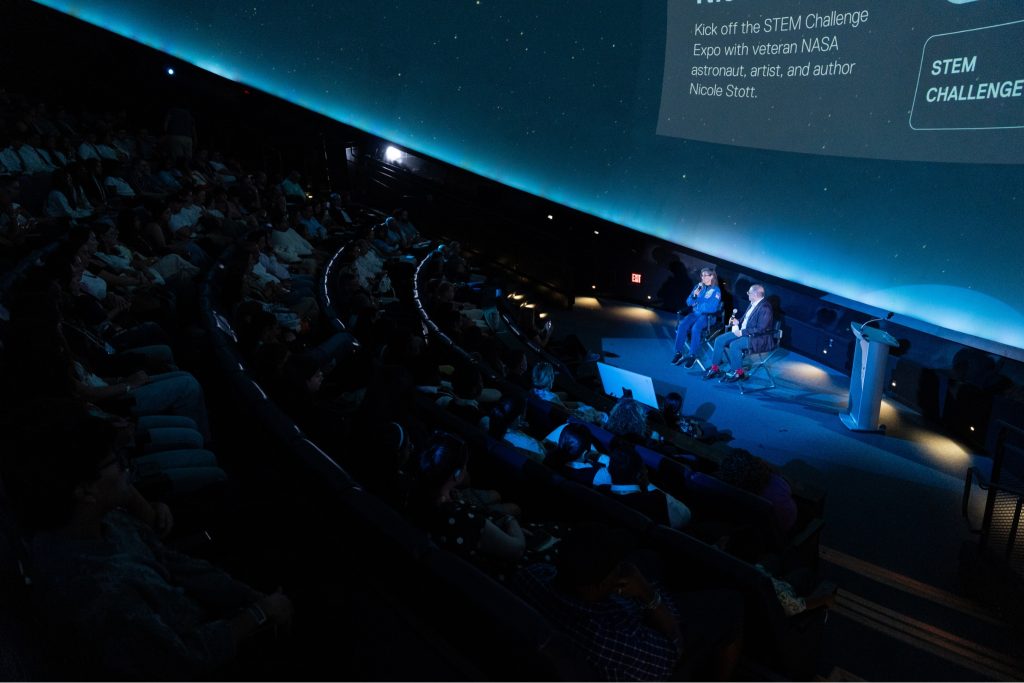
Each year, Frost Science’s STEM Challenge focuses on a central theme. Explore past themes, winners, videos and more below.
2025-2026 STEM Challenge
Innovating with Technology to Advance Science
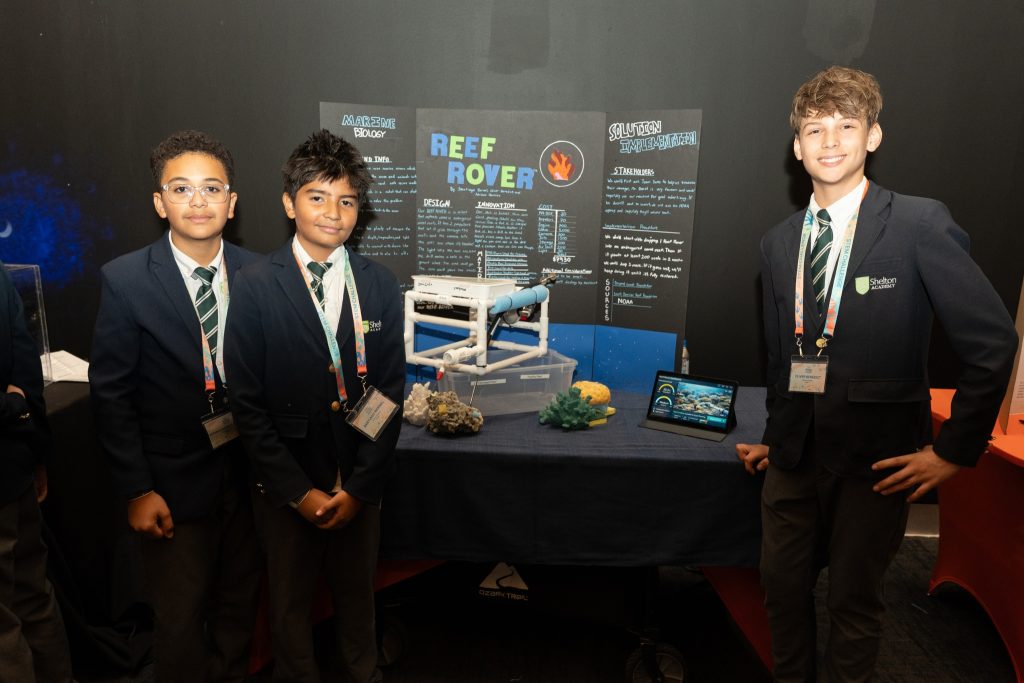
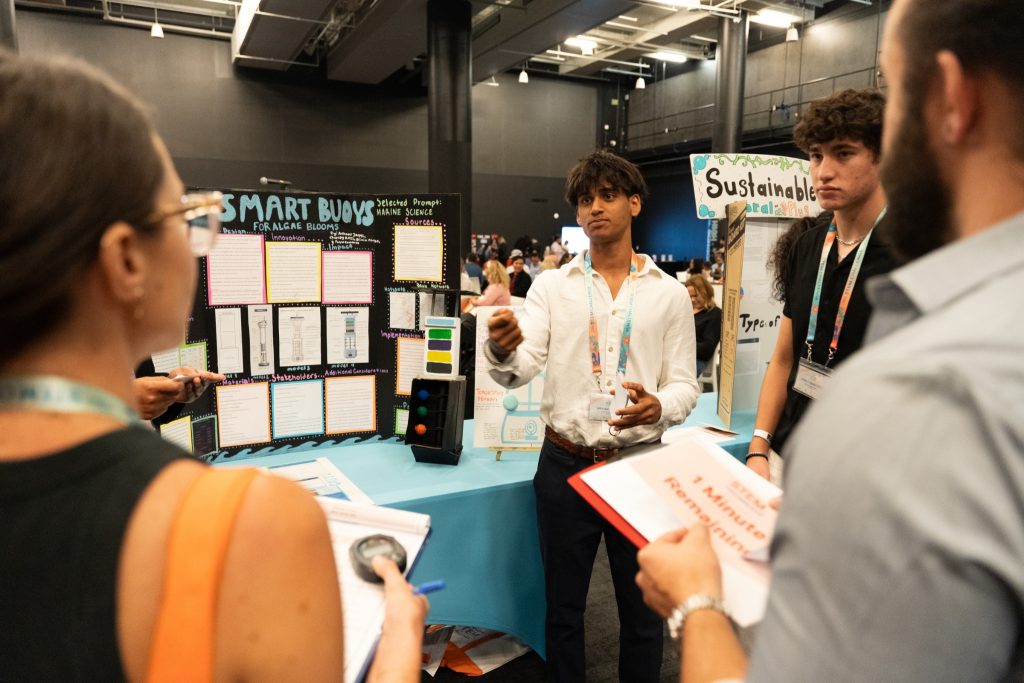
The 2025-2026 STEM Challenge encouraged students to explore how emerging technologies could advance science by developing innovative solutions or models. Using tools such as artificial intelligence, robotics, biotechnology, immersive tech, nanotechnology, wearables, implantables, and 3D modeling and printing, students responded to prompts focused on improving fossil access in extreme environments, monitoring marine activity, enhancing healthcare accuracy and accessibility, and supporting astronauts’ basic needs in space.
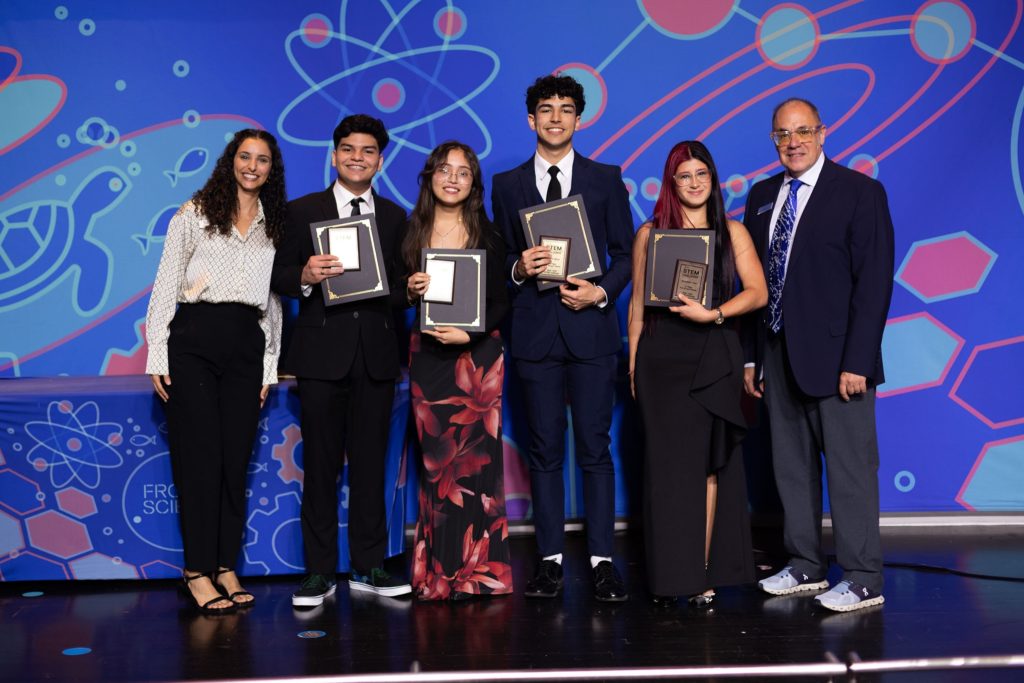
2026 Individual Project Winners
- 1st Place: Adaptive Adaptive Occupational Therapy Training System by a student at Shelton Academy
- 2nd Place: Sight Through Sense: Learning Without Limits by a student at Cardinal Gibbons High School
- 3rd Place: Smart Fracture Care by a student at Coral Springs Charter School
- Best Oral Presentation: VisoAdapt by a student at Cardinal Gibbons High School
- Best Model: Robo-Roach by a student at the Center for International Education
2026 Group Project Winners
- 1st Place: M-Sense by students at Cardinal Gibbons High School
- 2nd Place: BuoyBot by students at Miami Senior High School
- 3rd Place: Revolutionary Medical Emergency Response System (RMERS) by students at Coral Springs Charter School
- Best Oral Presentation: Vapor Vision by students at School for Advanced Studies – Wolfson Campus
- Best Model: NICARTH Autonomous Predictive Emotional Regulation System for Astronauts by students at J.C. Bermudez Doral Senior High School
2026 Middle School Project Winners
- 1st Place: Jupiter Autonomous Benthic Camera by homeschool students part of the Eco Scouts
- 2nd Place: The HydroSieve by students at New River Middle School
- 3rd Place: Space Debris by students at Palm Springs North K8 Academy
STEM Challenge projects will be evaluated in a rigorous two-stage judging process. While the first round of judging will occur virtually, the second round of judging will be held in-person at Frost Science. Winners of the STEM Challenge will receive college scholarships through Florida Prepaid. The scholarship amounts are as follows:
Individual Project Winners
- 1st Place: 4-year Florida University Plan
- 2nd Place: 3-year Florida University Plan
- 3rd Place: 2-year Florida University Plan
- Top Oral Presentation: 1-year Florida University Plan
- Top Model: 1-year Florida University Plan
Group Project Winners
- 1st Place: 3-year Florida University Plan
- 2nd Place: 2-year Florida University Plan
- 3rd Place: 2-year Florida University Plan
- Top Oral Presentation: 1-year Florida University Plan
- Top Model: 1-year Florida University Plan
Junior STEM Challenge Project Winners
- 1st Place: 1-year Florida University Plan
- 2nd Place: 1-year Florida University Plan
- 3rd Place: 1-year Florida University Plan
For winners to receive college scholarships through Florida Prepaid, they must have a valid Social Security Number, be less than 21 years of age, not have graduated high school, be a FL resident for 1+ year, and be a US citizen. If the winning student does not meet one of these criteria, Frost Science will work directly with the student to distribute the scholarship. Scholarships not distributed through Florida Prepaid will not qualify for the matched scholarship value and will be of lesser value.
Florida University Plans distributed through Florida Prepaid are designed to be used at public Florida state universities but may be applied to tuition at private and out-of-state schools. When these scholarships are applied to private and out-of-state schools, their monetary value will be applied to student tuition and will not cover the 1-to-4-year value that they would at a Florida state university.
Students may engage with resources as part of STEM Challenge activities or to continue learning after they have completed the STEM Challenge.
STEM Challenge Resources – Activity 2: Sound Sources
STEM Challenge Resources – Activity 4: Pitch Your Point
Free Resources
- Phillip and Patricia Frost Museum of Science: Frost Science will print 3D models for students participating in the STEM Challenge. These models will be printed on a small scale and model files must be sent to Frost Science 2 months prior to the necessary in-hand date. If you are interested in printing your STEM Challenge models for free, please send your STL files to education@frostscience.org
- AutoDesk: The AutoDesk Suite provides a wide variety of different software that range from simple 3D modeling to infrastructure design. Software provided in the AutoDesk suite are free for students with a valid school email-address.
- Tinkercad (Beginner): Tinkercad is a web-based AutoDesk software that allows users to create 3D models, circuits, and code. The circuits are compatible with Arduino and Micro:Bit and utilize block and Python coding. Tinkercad cannot be used to design circuits compatible with Raspberry Pi. Tinkercad is considered an easy-to-use software.
- Blender (Advanced): Blender is a 3D creation suite that has more capabilities than other 3D modeling software, like Tinkercad, and can create styled and photo-realistic 3D models, animations, simulations, and more. Because Blender has a lot of tools and settings, it also has a steep learning curve.
- GitHub (Intermediate-Advanced): GitHub is a platform where developers can create, store, manage, and share their code with other users. Like with any online download, code used for the STEM Challenge should only come from reliable sources to avoid encountering malware. The source for any code from GitHub used in a STEM Challenge project should be cited.
- Google Earth Studio (Beginner-Intermediate): Google Earth Studio is an online software that can be used to create animations and Virtual Reality scenes. Google Earth Studio utilizes Google Earth satellite and Street View imagery along with 3D building models.
- KIRI Engine (Beginner): KIRI Engine allows users to scan objects using their phone to create 3D models. The 3D models generated by KIRI Engine can then be exported and imported into other 3D modeling software, where the file can be edited.
- QGIS (Intermediate-Advanced): QGIS is a geographic information system (GIS) software. As a GIS software, QGIS allows users to analyze, display, and map location data. Uses for GIS maps include displaying weather data, identifying flood zones, monitoring deforestation, and urban planning.
- Teachable Machine (Beginner): Teachable Machine is a machine learning AI program. Users provide images and sounds to the Teachable Machine, and the AI will learn how to identify and categorize the provided media. The Teachable Machine can be exported and used in conjunction with coding.
- Unreal Engine (Advanced): Unreal Engine is a 3D graphics computer game engine. While this software is primarily used to create video games, it is also used to create simulations, VR/AR/MR, video, and more. Knowing C++ is advantageous when using the program.
- Visual Studio Code (VSCode) (Intermediate-Advanced): VSCode is an environment where users can write, debug, test, and compile code. VSCode requires a basic understanding of at least one programming language.
- Online Courses (Beginner-Advanced): Students can take free and paid courses that address a wide range of different topics, including coding, artificial intelligence, machine learning, and more.
STEM Challenge teachers can also reserve their Field Trip and the Meet the Museum Scientist opportunities by completing the Optional and Additional Engagements Form.
- Computer Science
- Environmental Science
- STEM Research Elective
- AP Biology
- Marine Science
- Ecology
- Health Science
- Earth and Space Science Honors
2024-2025 STEM Challenge
Climate Mitigation and Adaptation
The issues arising from the rapidly changing climate have become and will continue to be prevalent in our daily lives. The 2024-2025 STEM Challenge theme prompted students to think about real-world problems that scientists are facing as a result of climate change, while encouraging them to think creatively about applicable solutions.
2025 Group Project Winners
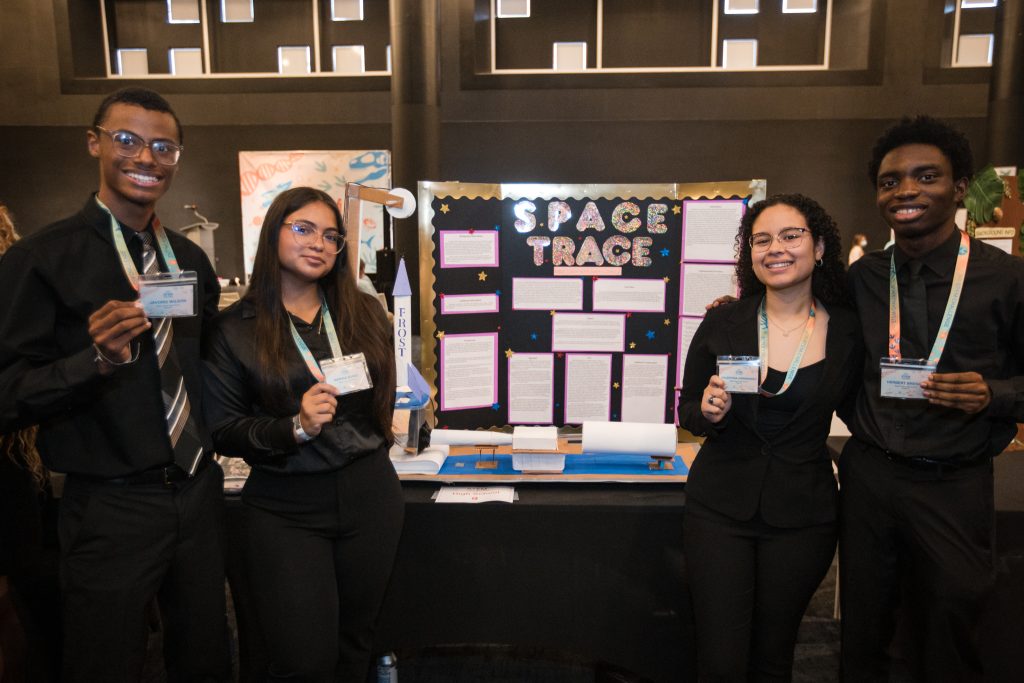
- 1st Place: Space Trace by students at Miami Senior High School
- 2nd Place: Presenting OlivAir to Health by students at Miami Southridge Senior High School
- 3rd Place: Taking a Seat Against the Heat Crisis by students at Center for International Education
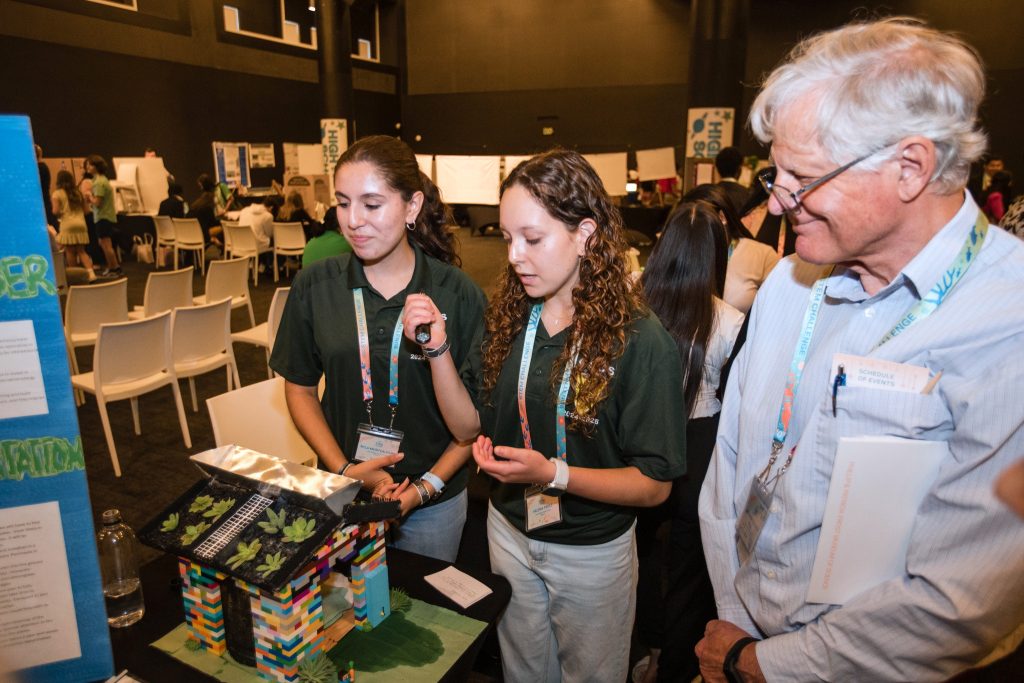
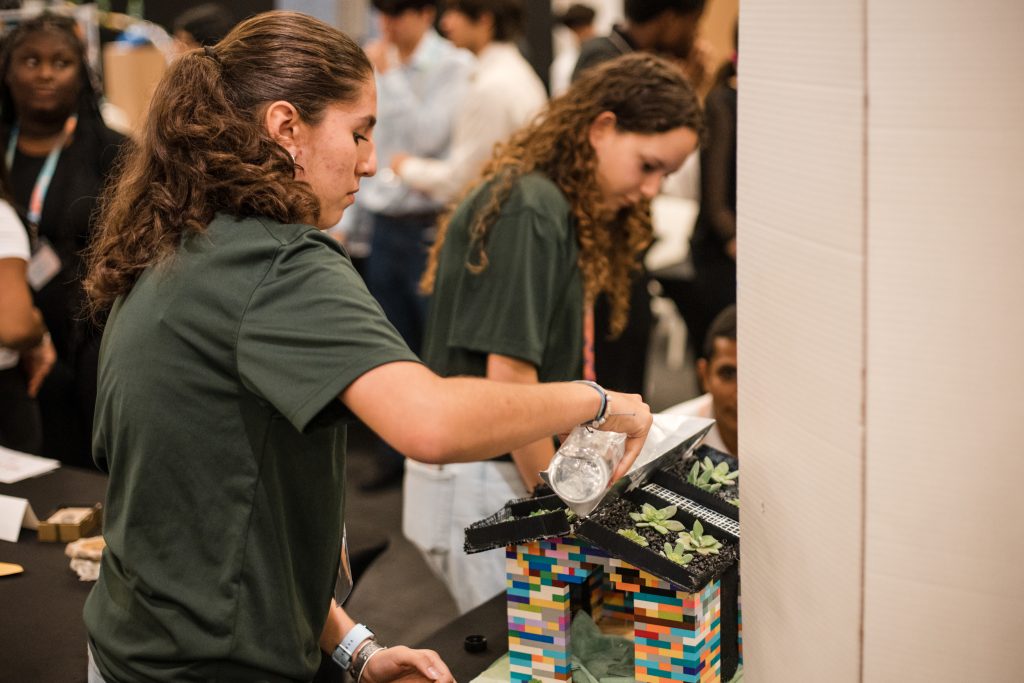
- Best Model: Casita Fresca by students at Coral Springs Charter School
- Best Oral Presentation: Fresh Flow by students at Center for International Education
2025 Individual Project Winners
- 1st Place: THE MANTA — Marine Autonomous Nurturing and Tending Apparatus by a student at Christopher Columbus High School
- 2nd Place: Coral Restoration Sanctuary by a student at Center for International Education
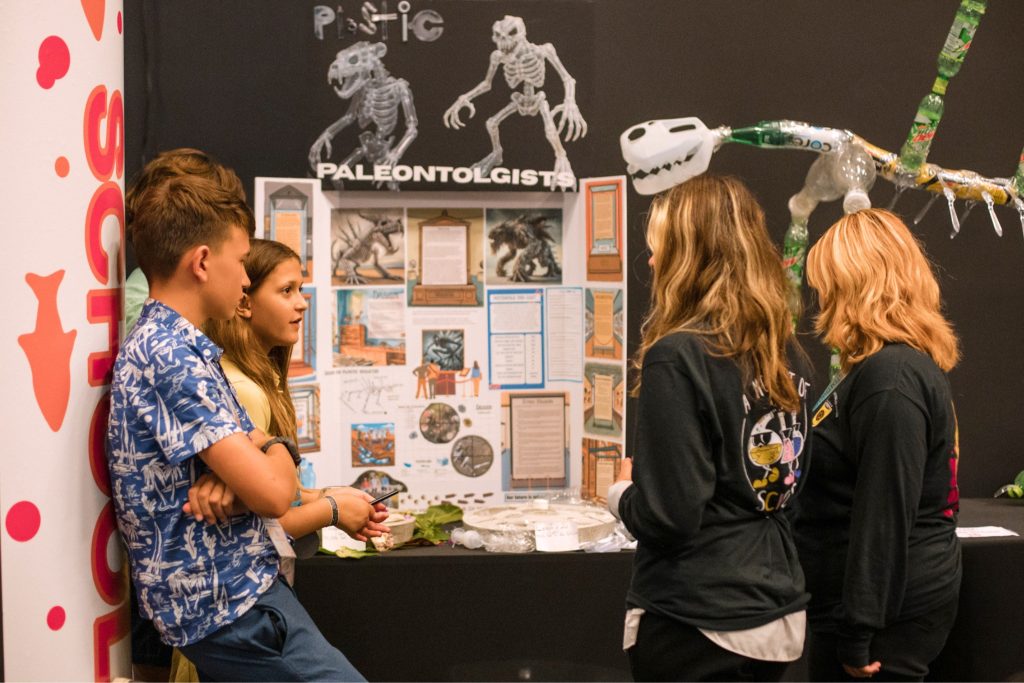
- 3rd Place: Paleontology and Human Impact by a student at William H. Turner Technical Arts High School
2025 Middle School Project Winners
- 1st Place: Save Our Oceans by students at Somerset Academy South Homestead
- 2nd Place: Celestial Wonders by students at Somerset Academy South Homestead
- 3rd Place: Climate Change Effects on Human Health by students at Somerset Academy South Homestead
Judges
- Carmen Alex, Prescott College
- Vladimir Baldelomar, Ph.D., Palm Beach School District
- Maya Bhalla-Ladd, Aspen Institute’s Energy and Environment Program
- Marisol Capellan, Ed.D., The Capellan Institute
- Katy Cummings, Florida Fish and Wildlife Conservation Commission
- Alexandra Fine, Florida Keys National Marine Sanctuary and National Oceanic and Atmospheric Administration
- Alex Harris, Miami Herald
- Robin Harrison, M.D. University of Miami
- Young Gu Her, Ph.D., University of Florida
- Daniel Jones, Miami-Dade Public Library System
- Dan Large, Phillip and Patricia Frost Museum of Science
- Ximena Lugo, Spearmint Energy
- Alexa Pavan, Conscious Content Clips and Friends of Our Florida Reefs
- Krizia Polanco, Miami EdTech
- Steven Pomerantz, Ed.D., Broward County Public Schools
- Wajida Qureshi, Miami Community Charter Schools
- Tej Rana, Highway Studio and Florida Engineering Society
- Maikel Right, Florida International University
- Tom Sargent, Ph.D., Marjory Stoneman Douglas Biscayne Nature Center
- Ned Robert Sauthoff, Ph.D., Princeton University (Retired) and Oak Ridge National Laboratory (Retired)
- Ankita Saxena, M.D., University of Miami
- Steve Sterling, Hologram Solutions & Technologies
- Ben Swaringen, Ph.D., Cornwell Engineering Group, Inc.
- Julia Wester, Ph.D., Miami Waterkeeper
- Cary Woodruff, Ph.D., Phillip and Patricia Frost Museum of Science
Photos and Videos